
Stock Market
The 3D Printing Financial Market
What are the stock market trends?
The 3D printing sector is evolving at such a rapid pace, particularly due to aggressive acquisition strategies, that attempting to synthesize the issue appears complex. Nevertheless, sector dynamics exist to help understand 3D printing stock market trends.
It is currently very difficult to ascertain which entities—users, material suppliers, software providers, printer manufacturers, or new dedicated services—will benefit most from the economic surplus generated. The question of where value lies is being asked by all investors, as well as 3D printing-specialized groups that are increasing acquisitions at all levels (in Europe, for example, the Gorgé group comes to mind). Consequently, some market capitalizations may have been overvalued. The acquisition of Makerbot by Stratasys for $403 million in summer 2013 exemplifies this stock market bubble, which speculated on the rapid penetration of personal 3D printers into homes, despite widespread agreement that numerous barriers to this movement still exist (public adoption of digital software, limited use).
The 30 largest 3D printing players have their own index on the New York Stock Exchange: the Stoxx Global 3D Printing Pure Play index. Since its introduction in 2011, values quadrupled by the end of 2013. The market capitalization of the leading American company, 3D Systems, nearly increased tenfold from 2011 to 2013. These capitalization levels suggested a new technology bubble, similar to the dot-com bubble of 2000. Indeed, market capitalizations exceeded the profit levels of these 3D printing companies by 60 times.
Indice boursier de l’impression 3D à la date du 12 décembre 2015 :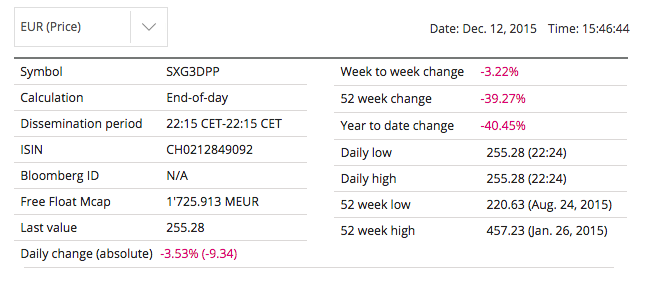
However, a correction occurred in early 2014 which, despite investor concerns, prevented a full collapse: the share price of the American company Stratasys, a heavyweight in this developing sector, fell by 26%, and 3D Systems Corporation's stock dropped by 48%. This was a dizzying decline, yet it did not affect the valuation level of these listed 3D printing groups, which remains very high, averaging 8 times their revenue.
It appears that financial markets have re-evaluated company valuations based on their actual industrial potential (solutions for mass customization) rather than the speculative fantasies that may have emerged in the early 2010s regarding the supposed imminent democratization of 3D printers. Investment announcements by new heavyweight entrants, such as Hewlett-Packard, Toshiba, and Google Alphabet, have likely reassured investors about companies' ability to further develop their R&D to achieve industrialization goals. For 2015, it is still too early to assess the year's stock market trends.
3D Printing: Towards a New Job Market?